Saturday, March 29, 2014

Cyclone Ian Aftermath...

Looking toward the cockpit on our very small plane to Ha'apai
Tuesday, February 4, Garth and I flew to Ha'apai, to see how things were going in the wake of Cyclone Ian. We flew up and back in one day, so our tour of Lifuka and Foa was quick. Pres. Steven Fehoko, a counselor in the mission presidency, had arrived in Ha'apai within days of the cyclone to help coordinate the clean up between the missionaries and bishops. What an amazing man he is. He is a master wood carver by trade.

He met us at the airport, and we got to briefly visit with Elders Montgomery and Ika (zone leaders in Ha'apai) as they headed to Tongatapu to attend the monthly Mission Leadership Council.

In the few weeks Pres. Fehoko had been on Ha'apai he had organized the missionaries into three groups. They would coordinate with the bishops and prioritize what needed to be done. The mornings were spent out working – fixing roofs, clearing debris, rebuilding, cutting fallen trees – whatever was needed. By the time we arrived, he had moved them out into the bush so farmland could be cleared of debris and crops could be replanted. The mission had sent steel-toed boots, long pants and shirts for the missionaries to wear while working, and chain saws to help with clean up. Pres. Fehoko assigned two men from each ward to be in charge of using the chain saws – missionaries were NOT allowed to use the chain saws – Pres. Fehoko wanted to make sure limbs remained intact :) He held a 30-minute “_____” to teach the men how to use and properly care for the chain saws. Many thought they didn't need the training, but Pres. Fehoko was adamant – no training, no chain saw.


Garth supervising the pruning of fallen trees

Two missionaries helping remove fallen trees
No chain saws for missionaries - only machete's
What a tree looks like after it's been "trimmed"

Afternoons when the temperature was at its highest, the missionaries rested. As evening approached the missionaries would divide – some would go back out to work, and others would clean up, put on their missionary attire, and go out proselyting. Many who had been inactive prior to the cyclone were coming back to church, and many nonmembers desired to learn more about the church. The numbers of members is steadily increasing in Ha'apai. God sometimes has to bring us low to bring us back to him.

Missionaries returning in the afternoon from working in the bush
There is still a lot of clean up that needs to be done, and there are still people staying in the LDS chapels at
A woman staying in the Pangai chapel
 night while working on their property during the day, but those numbers are decreasing. The government is still very slow to relinquish any goods – choosing to store them rather than give them out. Who can understand the machinations of a government bureaucratic mind. But the church, as usual, is there helping out. Not only are local members in Vava'u and Tongatapu helping by sending fresh produce, water, and other needed goods, but the church has given $100,000 so far, to buy supplies and whatever else is needed to help aid the cleanup. They are also working to begin building homes for those whose homes were destroyed. These homes will be built for anyone who lost theirs to the cyclone, whether an LDS member or not.

Sleeping boy in the Pangai chapel


The cultural hall in the Pangai chapel - temporary home for many
A visitor inside one of the Red Cross tents

A temporary home (tent) set up next to a home undergoing roof repairs

Downtown Pangai - tents donated by the Red Cross - they were very, very hot inside

When not working in the bush, a missionary is giving a haircut

Firefighters helping with cleanup

Students attending Ha'apai High School cleaning up the school grounds before school can start

Cleanup at Ha'apai High School

Missionary laundry hanging to dry in the cultural hall

Laundry hanging out to dry in the tennis court of the chapel

Laundry hanging to dry on the fence of the church grounds

Missionaries taking a break during the heat of the day

Beginning to rebuild

An elementary school - papers out drying on the lawn


Sima vai (water tanks) collecting rain water at one of the chapels

Faleloa - one of the hardest hit villages

Downed telephone lines and electrical lines - a common site

Minor damage to one of the LDS chapels - a door got blown off and was replaced - pink instead of blue :)


Cyclone Ian


Saturday, January 11, Cyclone Ian struck the Ha'apai island group of Tonga, with gusts reaching 178 mph. Watch on the cyclone began January 2, when it was categorized as a class 2 cyclone. It moved very slowly, was eventually upgraded to category 4, then category 5 before smashing into Ha'apai, with the eye of the storm passing directly over the main islands of Lifuka and Foa. It was estimated between 75 and 95% of all buildings were demolished among the 17 populated islands in the 51-island Ha'apai group. One life was lost due to injuries received from flying debris.

The cyclone passed by the Niuas and Vava'u causing some high wind gusts and some rain before stomping on Ha'apai, then passing by Tongatapu in the middle of the night with very little notice. I stayed up until after 3:00 a.m. waiting for the cyclone to hit. There was some wind and some rain....much, much lighter than other storms we've experienced thus far. I watched the wind change the direction the palm fronds were blowing, so I knew the eye of the storm had passed us by....and then I went to sleep. The cyclone was a big nonevent on Tongatapu.

By Monday the 14 stakes on Tongatapu began gathering clothing, tents, food, and other goods to send to the people of Ha'apai. They began collecting supplies at 10:00, and thought they would have everything

loaded on the ferry by noon. Truck load after truck load of goods began showing up at the ferry terminal. The line of trucks waiting to offload their supplies grew until it extended down the street. Drivers waited hours in line before they could unload their goods. Flour, sugar, vegetables, fruit, tents, tarps, clothing, saws, axes. The poorest of the poor gathered what extra they had and added it to the growing load. One lady, who only had a few dresses in her wardrobe, figured she really only needed one. She gave nearly her entire wardrobe to those who literally had nothing. Shortly after midnight the last or the trucks emptied its load. The ferry was full to overfilling. The hold was full, the walkways were full, every spare space on the ferry was full. Sister Webb, a humanitarian missionary who helped with the cyclone relief, said she wept the entire day.


By Tuesday morning the supplies were in Ha'apai and being unloaded. It was expected that the government would divide the goods. But, there were those who had their doubts that the people of Ha'apai would actually get said goods if the government became involved. So, a wise mission president (President Tupou) and area authority (Elder Tukuafu) suggested that the stake president in Ha'apai divide everything into equal amounts among the villages, and that the bishop and government representative of each village would then pass out the goods to ALL the people who resided in their village, regardless of religion. These supplies were the only supplies distributed among the people of Ha'apai until three weeks after the cyclone. Anything the government received they stockpiled in buildings, some of it going bad, until they finally got around to getting it to the people.

Sister Meyers, Sister Webb, Elder Webb
Tuesday Pres. Tupou, Elder Tukuafu, and Howard Niu (head of the service center in Liahona) chartered a plane to Ha'apai. Communications were still down, so they took a satellite phone with them. All missionaries had been accounted for and were helping with the clean up. While most of the other churches had sustained major damage – many of them losing entire roofs – 


the LDS churches and Mqs (missionary quarters) sustained minimal damage. 

LDS Church in background - empty foundation in foreground
L

MQ - Missionary Quarters
A very small section of a roof on one chapel had been lost, and a few doors had blown off. And most of the roof of the home the Va'enuku's lived in (a senior missionary couple) had blown off and they had to seek refuge in the service center. That was it. Residents all over Ha'apai ran to the LDS churches as the cyclone got near. And many of those who spent the first half of the cyclone NOT in an LDS church, ran to our churches during the lull of the storm when the eye passed over, because they knew the only safe places on the islands were the LDS churches.
One of the zone leaders, Elder Montgomery, shared with us a video he made during the first part of the cyclone. He and his companion had come to the main town of Pangai on the island of Lifuku to make sure the missionaries there were okay, and were unable to to get back to their village before the cyclone hit. So, they weathered the first part of the storm in the chapel in Pangai. His video shows palms bending nearly to the ground, debris flying, buildings being blown apart. Next to the church was a small Chinese store that had been completely demolished. During the lull in the storm looters began taking cans of food that was still within the vicinity of the store. Elder Montgomery and Elder Ika (the zone leaders in Ha'apai) ran out to help the Chinese owners pick up what they could to keep the looters from stealing it, and tossed everything into the back of the owner's van. Then the back side of the storm hit. They were barely able to make it into the van. Wind and debris pummeled the van. They were able to drive a short distance to a more secure location where they waited out the storm. Elder Montgomery said the building was small, dark, and they were unable to see anything. They could only hear the wind as it howled past them, and debris as it smashed into the building.

Cyclones are a way of life here. The people of Ha'apai are picking up and moving on. They are a strong people. The Lord blessed them and looked out for them. It is amazing to think that only one person lost their life. And there were no serious injuries. It is truly a miracle.

Here are some pictures two weeks after the cyclone hit.


Saturday, January 4, 2014

How We Spent Our Christmas - or High Adventures on the Open Sea: A "Real Tonga" Experience

Just sit right back and you'll hear a tale
A tale of a fateful trip,
That started from this tropic port,
Aboard this tiny ship.

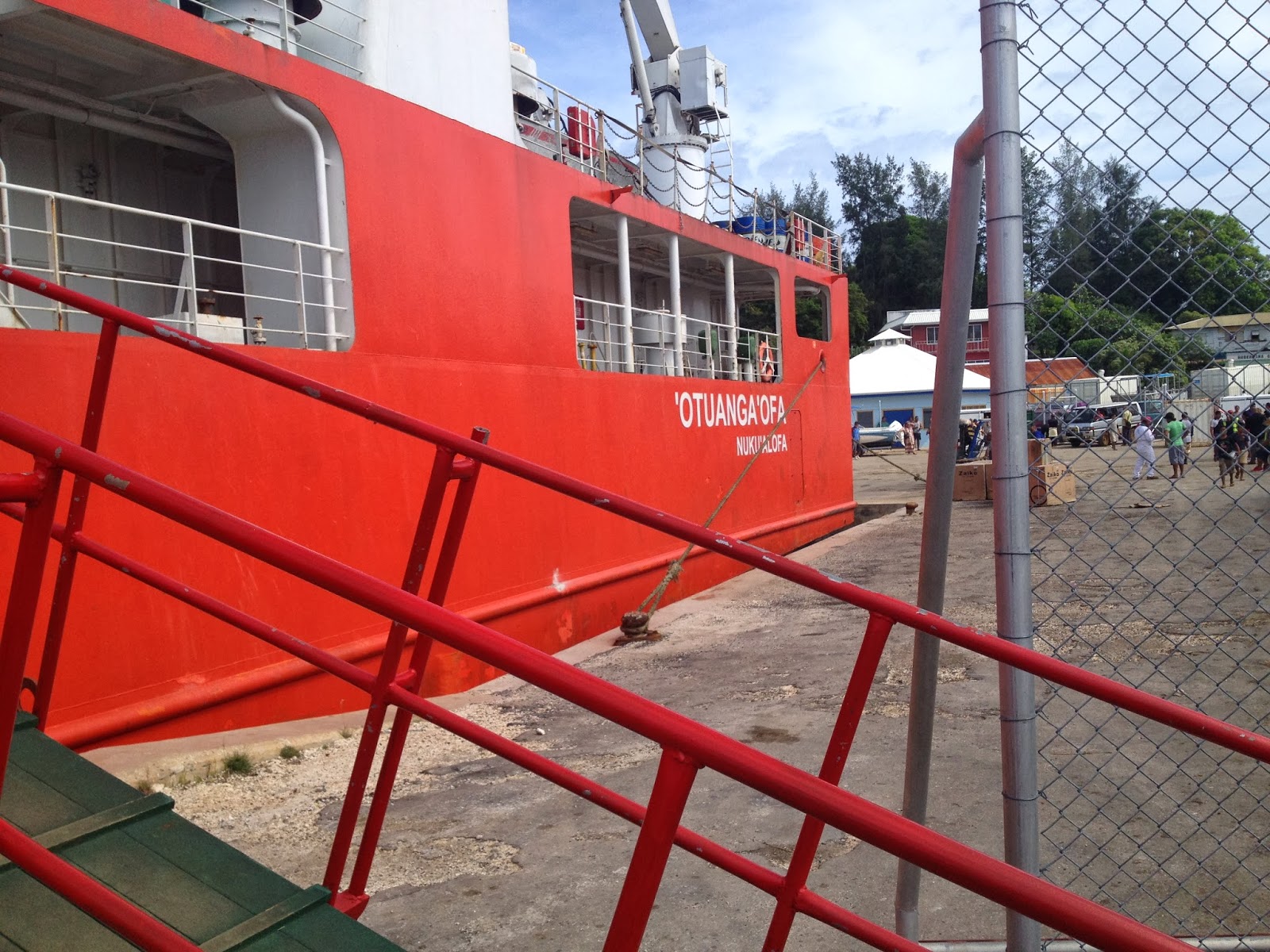
What started out as a four-day trip to Niuatoputapu, in the far northern reaches of the Kingdom of Tonga, turned into an 11-day ADVENTURE, with the last three days spent on the MV 'Otuanga'ofa, Tonga's inter-island ferry. This is no ordinary “people” ferry. It is part cargo boat, part passenger boat, with a great big crane on top of it, and containers stacked along the upper back deck.

President and Sister Tupou, Garth and I ended up on the 'Otuanga'ofa because our Real Tonga return flight from Niuatoputapu to Tongatapu never materialized. With Christmas on the horizon, and no planes coming to get us any time soon, we made the decision to brave “the boat.”


We boarded at the harbor in Falehau, braved the opening through the reef, and headed northwest, out into the open sea. I know, I know. Tongatapu's south of Niuatoputapu. So, why were we headed northwest? Because Niuafo'ou, which is northwest of Niuatoputapu, had bad weather when the ship was actually scheduled to arrive there, and the captain decided to come to Niuatoputapu first, THEN head to Niuafo'ou. So, we headed northwest. 


Everything was all fun and games for about the first hour. The ride was a little bumpy, but we were having an adventure! A real Tongan adventure!! Then Garth and I decided to get something out of our berth.


So....let me describe our berth. I was kind of expecting a small room, kind of like on the ferries we have in

Alaska. Nope. The steward (or at least one of the crew) took us down two decks. Yes, two. All the way down to deck one, all the way forward, into the bowels of the ship. He opened a door, and there were 10 sets of curtains, five on each side of a narrow hallway, which led to a door on the opposite side of the hall. At first it looked as if we were going to have to share a four-bunk room, but after some talking, Pres. Tupou convinced the crew member that we had paid for our own rooms, not shared rooms. So, we actually had a four-bunk room to ourselves – at least we had the appearance of being by ourselves when the curtain was drawn. Sounds still entered uninvited, however. The cabin two “doors” down from us liked to play music 24/7. And what a variety – everything from raggae to rap to Christian rock to country. And, of course, we could hear people's conversations if they weren't kept to a whisper. And there was the ever present sound of very sea sick people trying without luck to keep down their food.

Going down to our berth was not a good idea. It was a lot bumpier down there, and I learned another lesson – one of several I learned this trip. That romantic notion of standing on deck of a ship, the coolness of ocean breeze in your face, the roll of the sea beneath your feet, the wide open sea the only thing on the horizon........is sadly not for me. As soon as we got to our “room” I started feeling sick. We went back upstairs and outside to see if the coolness of the breeze would help....it did not. Up came dinner. Every half hour or so my insides tried to come outside. Garth, a much better sailor than I am, did what all good companions do, and stayed by my side through the night, letting me rest on his shoulder between bouts of dry heaves. Finally, after about 17 hours, we reached Niuafo'ou, and I was able to make it to my berth, where I stayed, venturing forth ONLY when at port.

After waiting for daylight to come so the boat could load and unload, and catching a few hours of sleep, I made my way to the deck to see what Niuafo'ou looked like. I was met by a most amazing site.
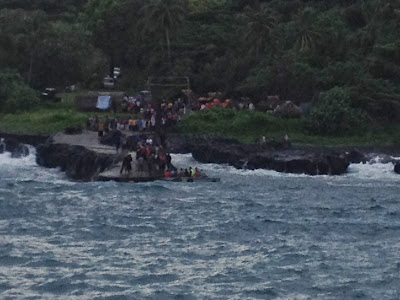
The crew was just lowering a flat-bottomed boat into the choppy waters to start ferrying people and all their paraphernalia to the dock.


But the dock wasn't actually a dock. The dock was a huge, sloped, mostly flat black rock jutting out into the water. And there were people on the end of it. And the waves were crashing up over it. I watched in amazement as the small boat, tied to the ferry at the bow and the stern, would be brought in close to the ferry, but not touching. And then people would jump down and across into the waiting boat, while it was moving in and out, up and down. Moms would hand off their babies and small children to the waiting crew members, who would hold tightly to them until the moms could get on board and find a place to sit. Then luggage was thrown on board, all the while people still trying to board. It was barely controlled chaos. As soon as the boat was a full as could be, it would head for the “dock” where the reverse would happen. Between waves crashing up against the “dock” people would disembark, their goods thrown up to waiting hands, and they'd make their way up to shore. At least five dozen eggs and four tires made it to shore in Niuafo'ou.


As soon as passengers for Niuafo'ou were ashore, and departing passengers on board the ferry, we took off...and I made my way quickly to my room...where I stayed until we reached Vava'u about 24 hours later. I gained a new appreciation of how Jonah must have felt in the belly of the whale. It was easy to believe the boat was some great beast, with us deep in its belly, as it groaned, growled, gurgled, and shuddered as we made our way south during the dark night ours.

A real live dock at last!!! We were able to disembark and walk around a little while in Vava'u. The market was in full swing as people bought last minute gifts and produce for Christmas dinner the next day.
The market on Vava'u


A Tongan water "taxi"


Then it was a “short” 7-hour ride to Ha'apai where we arrived after dark, and more people got off and even more got on. 
Sunset just before reaching Ha'apai
In the middle of the night we stopped at Ha'afeva and Nomuka before FINALLY arriving in Tongatapu at 10:00 Christmas Day morning. During our three-day boat ride I ate ½ peanut butter sandwich Tuesday afternoon, and drank one small bottle of water. I am sad that my stomach is such a wimp, and I will not be the sailor I always secretly wished to be.


 But, we are home once again – showered and clean, and soon to enjoy a Christmas dinner with the other senior missionaries on Tongatapu.


Merry Christmas!!!